

1/1
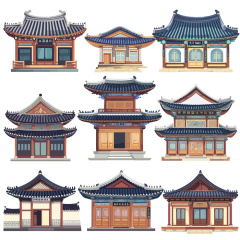
Collection of Nine Ancient Chinese Taoist Temple Architecture
File Type:EPS
This collection presents nine meticulously crafted icons of ancient Chinese Taoist temple architectures. Each icon captures the unique essence of Taoist architectural styles, featuring elements like upturned eaves, simple yet elegant layouts, and symbolic decorations. These icons not only showcase the aesthetic charm of Taoist temples but also embody the profound Taoist philosophy of harmony with nature, making them ideal for cultural exhibitions, educational materials, and Taoist - themed design projects.
Icon Details
2.1 Main Hall of Taoist Temple
- The main hall, the core of the Taoist temple, has gently upturned eaves and a gray - green glazed tile roof. Inside, there are statues of Taoist deities like Laozi. The hall's simple and solemn design reflects the Taoist pursuit of simplicity and nature.
- The exterior walls are often painted in earthy tones, blending with the surrounding environment. Carvings on the beams may include patterns of cranes, pine trees, and clouds, which are symbols of longevity and immortality in Taoism.
2.2 Taoist Temple Gateway
- The gateway to the Taoist temple features slightly upturned eaves and a stone structure. It is adorned with inscriptions of Taoist mottos or names of the temple. Two stone lions or mythical beasts stand guard on both sides, symbolizing protection of the sacred space.
- The gateway's design is concise, avoiding excessive decoration, in line with the Taoist concept of "plainness and simplicity". It serves as a transition from the secular world to the spiritual realm of the temple.
2.3 Meditation Pavilion in Taoist Temple
- A small open - air pavilion within the temple grounds, with curved upturned eaves and a wooden structure. It is surrounded by lush trees and a small pond, creating a quiet environment for monks to meditate and practice Taoism.
- The pavilion's roof is covered with light - colored tiles, and the railings are carved with patterns of bamboo and lotus, representing purity and resilience, which are valued in Taoism.
2.4 Taoist Temple Pagoda
- A multi - tiered pagoda in the Taoist temple, with each tier having subtly upturned eaves. The pagoda is usually made of stone or brick, with a simple and stable structure. It is used to store Taoist scriptures or as a place for spiritual cultivation.
- The surface of the pagoda may be engraved with Taoist symbols like the Yin - Yang diagram, embodying the Taoist view of the unity of opposites.
2.5 Alchemy Hall of Taoist Temple
- A specialized hall for alchemy practice, with a low - key appearance and slightly upturned eaves. The hall has large windows to allow sufficient light, and the interior is equipped with stoves and containers for alchemy.
- The roof tiles are dark gray, and the walls are decorated with paintings of celestial beings and natural scenes, reflecting the Taoist pursuit of immortality through alchemy.
2.6 Mountain - top Taoist Temple
- A Taoist temple built on the top of a mountain, with bold upturned eaves to withstand strong winds. It is surrounded by mist and rocks, creating a fairy - like atmosphere, which aligns with the Taoist belief in connecting with heaven.
- The temple's layout follows the mountain's terrain, with buildings scattered in an orderly manner. The main materials used are local stones and wood, integrating with nature.
2.7 Taoist Temple Library
- A hall for storing Taoist classics, with a compact structure and upturned eaves. The roof is covered with blue glazed tiles, symbolizing the sky. The interior has wooden bookshelves filled with ancient Taoist texts.
- Carvings on the doorframes depict scenes of immortals reading, emphasizing the importance of learning and inheriting Taoist teachings.
2.8 Waterfront Pavilion in Taoist Temple
- A pavilion located by a lake or stream within the temple, with gracefully curved upturned eaves. It is a place for monks to observe the water and gain insights into the Taoist philosophy of "the way of water".
- The pavilion's columns are made of bamboo, and the floor is paved with stone slabs. The reflection of the pavilion in the water creates a harmonious scene of "heaven and earth merging into one".
2.9 Taoist Temple Altar
- An open - air altar in the temple, with a square or circular shape and low upturned eaves around it. It is used for Taoist rituals and offerings to heaven and earth. The altar is surrounded by stone lanterns and incense burners.
- Symbols like the Eight Trigrams are carved on the altar's surface, representing the Taoist understanding of the universe's changes.
Design Features
- Harmony with Nature: All icons reflect the Taoist principle of integrating architecture with nature. The layouts follow the terrain, and the colors (mostly earthy tones, gray, blue) blend with the natural environment.
- Symbolic Decorations: Elements like the Yin - Yang diagram, Eight Trigrams, cranes, pine trees, and clouds are widely used, each carrying specific Taoist meanings related to immortality, balance, and the universe.
- Eaves and Roofs: The upturned eaves are usually gentle, avoiding excessive grandeur, and the roofs are simple, often with gray or blue tiles, embodying the Taoist pursuit of simplicity and frugality.
Application Scenarios
- Cultural and Religious Exhibitions: These icons can be used in exhibitions about Taoism and Chinese religious culture to display the unique architectural style of Taoist temples.
- Educational Resources: Suitable for textbooks and online courses on Chinese history, religion, and architecture, helping students understand the characteristics of Taoist temples.
- Taoist - Themed Design: Ideal for designing Taoist temple souvenirs, websites, and interior decorations of related cultural venues, adding an authentic Taoist cultural atmosphere.


