

1/1
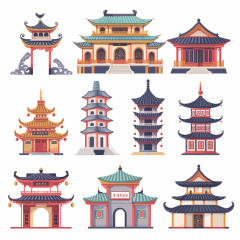
Collection of Ancient Chinese Architectural Icons
File Type:EPS
This collection of 10 ancient Chinese architectural icons showcases the grandeur and diversity of China’s architectural heritage, featuring four iconic building types: archways, temples, palaces, and pagodas. Each icon is a refined representation of key elements from these structures, capturing the essence of traditional craftsmanship, symbolic motifs, and structural ingenuity. From the imposing stone lions flanking archways to the upturned eaves of temples and the multi - tiered elegance of pagodas, these icons distill centuries of architectural wisdom into visually striking designs. They serve as a bridge between history and modern design, making them ideal for cultural projects, educational materials, digital interfaces, and artistic works that aim to celebrate ancient Chinese architecture.
Icon Details
2.1 Archway - Themed Icons
- Classic Archway Outline: This icon depicts the full silhouette of a traditional archway, with multi - layered roofs, decorative brackets, and symmetrical pillars. The clean lines highlight its iconic structure, symbolizing honor, commemoration, and the passage between spaces—a core function of archways in ancient China.
- Carved Railing Detail: Focusing on the intricate railings of archways, this icon features elaborate patterns such as intertwining dragons, phoenixes, and auspicious clouds. These carvings, rendered in simplified form, reflect the craftsmanship of ancient stone masons and the symbolic language of Chinese culture.
- Guardian Stone Lion: A stylized icon of the stone lion, a common fixture at archway entrances. The lion is depicted with a muscular build, a fierce yet noble expression, and a ball under its paw (symbolizing power), embodying protection and authority.
2.2 Temple - Themed Icons
- Temple Main Hall: This icon captures the grandeur of a temple’s main hall, with a steeply sloped roof, wooden brackets, and a central door flanked by windows. The design emphasizes the hall’s solemnity, making it a symbol of spiritual worship and religious harmony.
- Wooden Frame Structure: Highlighting the core of temple architecture—the wooden framework—this icon shows the interlocking system of columns, beams, and brackets. It showcases the "mortise - and - tenon" technique, a hallmark of ancient Chinese carpentry that enables structures to withstand time without nails.
- Upturned Eaves: A close - up icon of a temple’s upturned eaves, curved like the wings of a bird in flight. This design not only adds elegance but also serves practical purposes like rain drainage, embodying the fusion of form and function in traditional architecture.
2.3 Palace - Themed Icons
- Imperial Palace Facade: This icon depicts the grand facade of a palace, with golden - tiled roofs, red walls, and multiple tiers of halls. The symmetry and grand scale reflect imperial authority and the hierarchical order of ancient court life.
- Palace Courtyard: Focusing on the inner courtyard—a central feature of palace design—this icon shows the layout of surrounding halls, corridors, and an open central space. It symbolizes the balance between privacy and community in imperial living.
- Dragon - Decorated Roof Ridge: A detailed icon of the dragon sculptures on palace roof ridges. Dragons, symbols of imperial power, are shown coiled along the ridge, with scales and claws rendered in simplified form to highlight their majesty.
2.4 Pagoda - Themed Icons
- Multi - Tiered Pagoda: This icon presents the full form of a pagoda, with 5 - 7 tiers, a tapering silhouette, and small windows on each level. It captures the pagoda’s role as a bridge between heaven and earth, common in Buddhist architecture.
- Pagoda Base and Finial: Highlighting the pagoda’s foundation and top ornament, this icon features a sturdy stone base (symbolizing stability) and a pointed finial (representing spiritual ascent). The combination reflects the pagoda’s dual purpose of storing relics and inspiring devotion.
Design Features
- Simplified yet Authentic: Each icon retains key structural and decorative details while using clean lines and minimal shading, ensuring clarity in both small and large applications.
- Symbolic Color Palette: Colors draw from traditional architectural hues—red (prosperity), gold (imperial power), gray (stone), and brown (wood)—enhancing cultural authenticity without overwhelming the design.
- Consistent Style: All 10 icons share a cohesive visual language, with balanced proportions and a focus on silhouette, making them versatile for mix - and - match use in projects.
Application Scenarios
- Cultural and Educational Materials: Perfect for textbooks, museum guides, or online courses on Chinese history and architecture, helping to illustrate key concepts visually.
- Digital Interfaces: Ideal for apps, websites, or software related to travel (e.g., heritage site maps), cultural tourism, or historical games, adding a thematic touch to user interfaces.
- Art and Merchandise: Suitable for prints, stickers, or merchandise (e.g., notebooks, posters) targeting enthusiasts of Chinese culture, blending historical charm with modern aesthetics.
- Event Branding: Useful for cultural festivals, exhibitions, or academic conferences focused on ancient China, providing recognizable visual elements for logos, banners, and tickets.


