

1/1
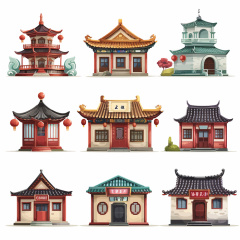
Collection of 9 Sets of Small Traditional Chinese Religious Architecture Icons
File Type:EPS
This collection features 9 sets of icons, presenting the unique charm of small traditional Chinese religious architectures. These icons highlight the distinct architectural features, delicate decorations, and profound religious atmosphere of different religious buildings in China, such as Buddhist temples, Taoist shrines, and Islamic mosques. They are excellent resources for cultural promotion, educational materials, and creative design.
Icon Details
2.1 Icon Set 1: Small Buddhist Pagoda
- Icon Features: This is a multi - storey brick pagoda with a square base. The pagoda has a slender body, and each storey has a set of small, arched windows. The eaves of each storey are slightly upturned, supported by simple brackets. At the top of the pagoda, there is a metal spire with several rings. The surface of the pagoda is decorated with relief carvings of Buddhist symbols like the lotus flower and the eight - treasure pattern.
- Cultural Significance: Pagodas in Buddhism are often used to enshrine Buddhist relics or scriptures. The square base represents stability, and the lotus flower symbolizes purity and enlightenment. The pagoda is a symbol of the Buddhist faith and the pursuit of spiritual transcendence.
2.2 Icon Set 2: Taoist Shrine with a Pavilion
- Icon Features: The shrine consists of a main hall and a small pavilion. The main hall has a sloping roof with upturned eaves, covered with grey tiles. The wooden doors and windows of the hall are decorated with carvings of Taoist immortals, such as Laozi and Zhang Daoling, as well as symbols like the yin - yang fish and the eight trigrams. The pavilion next to the hall has a circular roof and is supported by four red - painted wooden columns. There is a stone incense burner in the center of the pavilion.
- Cultural Significance: Taoist shrines are places for Taoist believers to worship and practice. The yin - yang fish and the eight trigrams are fundamental symbols in Taoism, representing the balance of the universe and the laws of nature. The carvings of immortals show the reverence for Taoist deities.
2.3 Icon Set 3: Small Islamic Mosque with a Minaret
- Icon Features: The mosque has a rectangular layout with white - washed walls. The main prayer hall has a flat roof. There is a slender minaret on one side of the mosque. The minaret is made of stone, with several levels and small balconies. The entrance of the mosque has an arched doorway, decorated with geometric patterns and Arabic calligraphy. Inside the prayer hall, there are no images, but the walls are adorned with beautiful Islamic patterns.
- Cultural Significance: Mosques are the center of Islamic religious activities. The minaret is used to call believers to prayer, and the geometric patterns and Arabic calligraphy are important elements in Islamic art, expressing the beauty and solemnity of the Islamic faith.
2.4 Icon Set 4: Buddhist Temple with a Courtyard
- Icon Features: This temple is centered around a small courtyard. The main hall faces the courtyard, with a double - eaved roof. The hall is supported by thick wooden columns. The eaves are decorated with small bells. On both sides of the courtyard, there are two - storey side halls. The walls of the halls are painted with murals depicting Buddhist stories, such as the life of Sakyamuni. There is a small pond with lotus flowers in the courtyard.
- Cultural Significance: The courtyard in a Buddhist temple represents a peaceful and pure space. The murals are a way to spread Buddhist teachings, and the lotus flowers in the pond symbolize purity, in line with the Buddhist concept of enlightenment.
2.5 Icon Set 5: Taoist Temple in a Mountainous Area
- Icon Features: The temple is built on a mountainside, following the terrain. It has a series of connected buildings with sloping roofs. The main building has a large, red - painted door. The walls are made of local stones and wooden planks. There are several small shrines dedicated to different Taoist deities along the paths. The temple is surrounded by pine trees, and there is a small stream flowing nearby.
- Cultural Significance: Taoist temples in mountainous areas often emphasize the harmony between man - made structures and nature. The pine trees are symbols of longevity and perseverance in Chinese culture, and the location in the mountains reflects the Taoist pursuit of seclusion and connection with nature.
2.6 Icon Set 6: Small Islamic Prayer House
- Icon Features: The prayer house is a simple, one - storey building with a sloping roof. The exterior walls are painted light blue. There is a small, arched window on each side. The entrance has a wooden door with Islamic - style ironwork. Inside, the floor is covered with carpets, and there is a niche in the wall indicating the direction of Mecca.
- Cultural Significance: This small prayer house provides a place for local Muslims to perform daily prayers. The blue color is often associated with peace and tranquility in Islamic culture, and the niche for the direction of Mecca is essential for the proper conduct of prayers.
2.7 Icon Set 7: Buddhist Meditation Hall
- Icon Features: The meditation hall is a square - shaped building with a single - eaved, gable - style roof. The walls are thick and made of brick. There are several small, round windows for ventilation. The entrance is a large, wooden door. Inside, there are rows of meditation cushions on the floor. The hall is decorated with a large Buddha statue at the front and simple Buddhist banners on the walls.
- Cultural Significance: The meditation hall is a sacred space for Buddhist monks and believers to practice meditation and seek spiritual enlightenment. The Buddha statue serves as a focal point for concentration, and the simple decoration helps create a quiet and peaceful atmosphere.
2.8 Icon Set 8: Taoist Pavilion for Alchemy
- Icon Features: The pavilion has a hexagonal shape with a pointed roof. It is made entirely of wood, with red - painted columns. The roof is covered with green - glazed tiles. There are lattice - work windows on each side of the pavilion. Inside, there is an alchemy furnace in the center, surrounded by some shelves with small jars and tools.
- Cultural Significance: Alchemy was an important part of Taoist practice in ancient times. The hexagonal shape of the pavilion may symbolize the six directions in Chinese cosmology. The alchemy furnace represents the Taoist pursuit of immortality and the transformation of substances.
2.9 Icon Set 9: Small Temple with a Pagoda - like Structure
- Icon Features: This temple combines a main hall and a pagoda - like structure. The main hall has a traditional Chinese - style roof with upturned eaves. The pagoda - like structure next to it has three storeys, with each storey having different - sized arched openings. The building materials include bricks and wood. The temple is surrounded by a low stone wall, and there is a small gate at the entrance.
- Cultural Significance: The combination of the hall and the pagoda - like structure shows the integration of different religious architectural elements. It may be a place for both worship and the preservation of religious artifacts, representing the complexity and diversity of Chinese religious culture.
Design Features
- Religious Symbolism: Each icon is rich in religious symbols, from Buddhist lotus flowers to Taoist yin - yang fish and Islamic geometric patterns, which vividly express the essence of different religions.
- Adaptation to Function: The designs are tailored to the specific functions of religious activities, such as meditation halls for quiet practice and mosques with clear - cut prayer - related elements.
- Local Material Use: Incorporating local materials like stone, wood, and bricks, these icons reflect the characteristics of different regions in China, while also demonstrating the practicality and beauty of traditional construction methods.
Application Scenarios
- Education: These icons can be used in religious education courses, history classes, and art appreciation lessons to help students better understand Chinese religious architecture and culture.
- Cultural Promotion: In cultural exhibitions, tourism brochures, and online cultural platforms, they can be used to showcase the diversity and profundity of Chinese religious cultures, attracting more people to explore and appreciate them.
- Design: Designers in the fields of architecture, interior design, and cultural - creative products can draw inspiration from these icons to create unique works that blend traditional religious elements with modern aesthetics.


