

1/1
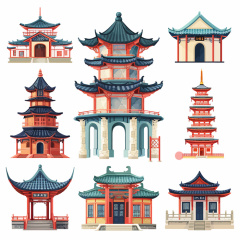
Collection of 7 Sets of Icons of Chinese Classical Architecture
File Type:EPS
This collection showcases 7 sets of meticulously - crafted icons, vividly presenting a variety of Chinese classical architectural types, including pavilions, ancient temples, pagodas, and towers. Each icon seamlessly blends the elegance and grandeur of traditional Chinese architecture with modern design concepts, highlighting their unique styles and profound cultural connotations. It serves as an excellent resource for cultural promotion, educational purposes, and creative design projects.
Icon Details
2.1 Icon Set 1: Pavilions
- Icon Features: Pavilion icons in this collection display structures with diverse shapes, such as square, hexagonal, or octagonal. They are typically open - air, supported by red - painted wooden columns, which may be adorned with simple carvings. The single - eaved roofs have a gently sloping profile and upturned eaves, exuding a sense of lightness and grace. Inside the pavilion, there are often stone benches and tables, providing a cozy space for rest. The pavilion is surrounded by beautiful gardens, featuring flower beds, rockeries, and sometimes a small stream or pond, integrating harmoniously with the natural environment.
- Cultural Significance: Pavilions have long been important gathering places in traditional Chinese gardens. They were used for various activities, such as enjoying the scenery, hosting banquets, or engaging in cultural pursuits like poetry recitals and music performances. The design of pavilions reflects the traditional Chinese pursuit of harmony between man and nature, as well as the refined taste of the literati and the upper class.
2.2 Icon Set 2: Ancient Temples
- Icon Features: Ancient temple icons depict large - scale, solemn buildings. The main halls of the temples usually have multi - eaved roofs, often in the form of double - eaved hip - and - gable roofs, which are a symbol of high status in traditional architecture. The roofs are covered with gray or black tiles, giving a sense of stability and solemnity. The temples are supported by thick, red - painted wooden columns, with intricate carvings of dragons, phoenixes, or other auspicious symbols, representing imperial power and good fortune. The front of the main hall has large, double - leaf wooden doors, decorated with brass fittings and elaborate carvings. Inside the temple, there are usually large Buddha statues or other religious sculptures, and the walls may be adorned with murals telling religious stories.
- Cultural Significance: Ancient temples are the core of religious activities in traditional Chinese society. They are places for people to worship, pray, and seek spiritual sustenance. Temples also play an important role in preserving and transmitting traditional Chinese culture, as they often house precious religious artifacts, scriptures, and works of art.
2.3 Icon Set 3: Buddhist Pagodas
- Icon Features: Pagoda icons in this collection generally show multi - storeyed structures, usually with an odd number of levels, such as five, seven, or nine, which holds special significance in Buddhism. The body of the pagoda is constructed with high - quality bricks or stones, adorned with delicate carvings of Buddhist motifs, including lotus flowers, Buddha statues, and auspicious clouds. The eaves of each storey are broad and gracefully curved, with upturned corners, giving the pagoda a sense of lightness and elegance. At the top of the pagoda, there is a spire, often decorated with precious metals or jewels, symbolizing the pinnacle of Buddhist enlightenment. The base of the pagoda is large and solid, sometimes surrounded by a carved balustrade.
- Cultural Significance: Buddhist pagodas were originally built to enshrine the relics of the Buddha or important Buddhist scriptures. In Chinese culture, they also came to symbolize spiritual power, good fortune, and the pursuit of enlightenment. Pagodas are important landmarks in the landscape, adding a touch of solemnity and mystery to the surroundings.
2.4 Icon Set 4: Towers
- Icon Features: Tower icons represent tall, multi - storey buildings. These towers have a square or rectangular base, with walls made of brick or stone. The windows are either rectangular or feature lattice - work patterns, providing ventilation and a view of the surrounding scenery. The roofs can be single - eaved or multi - eaved, depending on the function and importance of the tower. Some towers may have a hip - and - gable roof, while others may have a pavilion - style roof. The exteriors of the towers are often decorated with painted murals, which may depict historical events, mythological stories, or beautiful natural landscapes. There are also balconies on each storey, surrounded by wooden railings with intricate patterns, adding to the aesthetic appeal of the tower.
- Cultural Significance: Towers in traditional Chinese architecture had multiple functions. They could be used for observation, providing a vantage point to overlook the surrounding area. Some towers were also used for storing important documents, treasures, or as places for study and meditation. In addition, towers were important elements in the overall architectural composition of a city or a garden, contributing to its grandeur and visual interest.
2.5 Icon Set 5: Arched Bridges
- Icon Features: Arched bridge icons show bridges with a graceful, curved arch that spans over a body of water, such as a river, stream, or pond. The arches are usually made of stone or brick, and are supported by sturdy piers. The bridge deck is flat and wide, allowing people and vehicles to pass through easily. On both sides of the bridge, there are stone or wooden railings, which may be decorated with carvings of flowers, animals, or other decorative motifs. The arches of the bridge are often reflected in the water, creating a beautiful and harmonious visual effect.
- Cultural Significance: Arched bridges are not only functional structures for crossing water but also important aesthetic elements in traditional Chinese landscapes. They symbolize the connection between different areas and the harmonious coexistence of man - made structures and nature. Bridges are often depicted in traditional Chinese paintings and poems, and are an integral part of the cultural heritage of China.
2.6 Icon Set 6: Gatehouses
- Icon Features: Gatehouse icons represent the imposing entrance structures. They are usually large, multi - storey buildings with a massive, fortified base made of thick stone or brick. The lower part of the gatehouse has a large, arched gate in the middle, often decorated with brass fittings, iron studs, and elaborate carvings of imperial symbols, such as dragons, phoenixes, and clouds. Above the gate, there are one or more storeys of wooden structures, with windows and balconies. The roofs of the gatehouse are multi - eaved, with a prominent central ridge and upturned eaves. The eaves are decorated with rows of small, decorative tiles or wooden brackets. On the top of the gatehouse, there may be a flagpole or a decorative finial.
- Cultural Significance: Gatehouses mark the boundary of an important area, such as a palace, a temple, or a private estate. They serve as a symbol of power, security, and status. The grand design and decoration of gatehouses not only reflect the importance of the enclosed area but also demonstrate the wealth and influence of the owner.
2.7 Icon Set 7: Corridors
- Icon Features: Corridor icons depict the long, covered walkways that connect different buildings. These corridors are supported by wooden columns, which are painted red and may have simple carvings. The roof of the corridor is a continuous, sloping structure, covered with gray tiles. The corridor walls may be decorated with painted murals or have lattice - work windows, allowing for views of the garden while providing shelter from the elements. There are also benches along the corridor, where people can rest as they stroll through the area.
- Cultural Significance: Corridors play a crucial role in the circulation and spatial organization of traditional Chinese architecture. They provide a convenient and sheltered way for people to move between different buildings, especially during inclement weather. The corridors also serve as a visual link, unifying the various parts of a building complex and creating a sense of continuity and flow. Additionally, the decorative elements on the corridors add to the overall aesthetic charm of the architecture.
Design Features
- Traditional Aesthetics: The icons strictly adhere to the traditional aesthetics of Chinese classical architecture. They feature elements such as symmetry, elegance, and elaborate decoration. The use of colors, such as red for columns and gray or black for roofs, is in line with the historical color - coding system in traditional architecture. The architectural forms, such as roof styles, columns, and carvings, are accurately rendered to reflect the unique style and craftsmanship of Chinese classical architecture.
- Cultural Symbolism: Each icon is rich in cultural symbolism. Imperial symbols, such as dragons and phoenixes, represent power and nobility. Buddhist motifs in pagoda icons reflect the influence of Buddhism in Chinese culture. Natural elements, such as flowers, plants, and water, symbolize the harmony between man and nature, which is a fundamental concept in traditional Chinese philosophy. The layout and design of the icons also follow the principles of feng shui, aiming to create a harmonious and auspicious environment.
- Attention to Detail: Despite being in icon form, great care has been taken to capture every minute detail. The carvings on columns, doors, and bridges, the design of railings and roofs, and the layout of each building type are all precisely depicted. This allows viewers to appreciate the unique features of Chinese classical architecture and understand the historical and cultural context in which these structures were built.
Application Scenarios
- Educational Resources: These icons are highly suitable for use in educational materials, such as history textbooks, art history courses, and educational apps. Teachers can use them to illustrate the architectural achievements and cultural significance of traditional Chinese architecture, helping students better understand the rich historical and cultural heritage of China. For example, in a history class on ancient China, these icons can be used to show the different types of buildings and their functions, enhancing students' learning experience.
- Cultural and Artistic Projects: In cultural and artistic projects, such as museum exhibitions, cultural festivals, and art installations, these icons can be used to promote Chinese traditional culture. They can be printed on posters, brochures, or used as part of digital displays to attract the public's attention and showcase the beauty of traditional Chinese architecture. For instance, in a museum exhibition on Chinese classical architecture, these icons can be used to represent the different architectural elements, providing a visual overview of the architecture's development and characteristics.
- Design and Creative Work: Designers in various fields, such as graphic design, interior design, and game design, can draw inspiration from these icons. The unique architectural styles and cultural elements of traditional Chinese architecture can be incorporated into modern designs to add a touch of historical and cultural charm. In graphic design, the patterns and colors from these icons can be used in the design of Chinese - themed posters or book covers. In interior design, the layout and decorative elements of classical buildings can be adapted to create a luxurious and elegant space. In game design, these icons can be used to create immersive virtual environments that are rich in historical and cultural details.


