

1/1
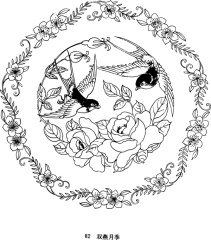
Chinese Embroidery Black & White Line Draft Template: Two Swallows with Chinese Rose (Yueji) Composition
No.
SKU:
File Type:AI
This Chinese embroidery black & white line draft template captures the vibrant elegance of a spring garden, depicting two agile swallows interacting with clusters of blooming Chinese roses (Yueji)—one swallow perched on a rose stem, beak gently brushing a petal, and the other in mid-flight above the blooms, as if drawn to their fragrance. Rooted in traditional Chinese “flower-and-bird” aesthetics (where seasonal birds and lush blooms symbolize prosperity and joy), the design uses nuanced line variation to distinguish textures: sharp, streamlined strokes define the swallows’ sleek feathers and forked tails, soft, layered lines shape the rose petals’ fullness, and thin, sturdy lines craft the rose stems and thorns. Rendered in monochrome, it balances the swallows’ dynamic energy with the roses’ quiet opulence, making it an exquisite foundation for embroidery projects celebrating spring, harmony, and the beauty of nature’s abundance.
Design Details
Textured Linework & Spring Elegance
A. Central Motif: Two Swallows
The swallows embody lightness and curiosity, their postures capturing the “playful connection to blooms” while blending with the roses’ lush backdrop:
- First Swallow (Perched on Rose Stem): It sits upright on a thick, slightly curved rose stem, body turned toward a fully opened rose. Its plumage is rendered in sharp, continuous lines: smooth strokes for the back and wings (with faint parallel lines to mimic feather layers, emphasizing sleekness), and shorter, softer lines for the underbelly (adding subtle contrast without disrupting its streamlined shape). Its head is tilted downward, with a short, pointed beak (thin, curved line) gently touching a rose petal—suggesting curiosity or admiration. Round, bright eyes (tiny dot pupils framed by a thin curve) convey warmth, and its iconic forked tail is tucked slightly (two sharp, symmetrical lines) for balance. Its claws (tiny, curved lines) grip the stem tightly, avoiding the small thorns (minuscule, pointed lines) on the stem’s surface.
- Second Swallow (Mid-Flight Above Blooms): It hovers just 3-4 cm above the rose clusters, body angled upward—wings outstretched in a gentle “V” shape. Its lines are slightly lighter to suggest airiness, with wing edges defined by crisp strokes to highlight movement. Its head is turned toward the perched swallow, creating a sense of interaction, and its beak is closed (thin, straight line) as if gliding softly. Faint, wispy lines trail behind its wings to mimic the blur of flight, keeping the design dynamic yet elegant. Both swallows have no excess detail—their forms stay crisp and agile, honoring their role as “spring’s lively messengers.”
B. Complementary Motif: Chinese Rose (Yueji) Clusters
Roses form a lush, colorful backdrop (implied through line density), framing the swallows and adding spring opulence:
- Rose Blooms: Three key blooms anchor the scene, each with distinct stages of opening:
- Fully Opened Rose: Positioned beside the perched swallow, with 8-10 layered petals (soft, curved lines with subtle ruffled edges—true to Chinese roses’ full, lush shape). The center is a small, rounded shape with tiny dot-like lines (representing stamens), adding realism.
- Half-Opened Rose: Resting on a secondary stem, with petals partially unfurled (curved lines that curl inward slightly) to reveal the emerging center. Petal edges are slightly more defined to emphasize texture.
- Tight Bud: Clustered near the flight path of the second swallow—an oval shape with a pointed top (thicker lines to suggest fullness), wrapped in small, leaf-like sepals (short, curved lines) with tiny thorns.
- Rose Stems & Foliage: Thick, sturdy stems connect the blooms, rendered in thin lines with faint vertical texture strokes (mimicking the stem’s smooth surface) and small, pointed thorns (minuscule, jagged lines) scattered along the length. Heart-shaped rose leaves adorn the stems—each with a thick central vein (straight line) and branching secondary veins (thin, curved lines). Leaf edges are serrated (soft, jagged lines) to mimic natural texture, and leaves are placed to frame the swallows without overcrowding.
Composition & Flow
The design follows a “circular harmony” flow: the perched swallow and fully opened rose form a focal point on the left, while the flying swallow and half-opened rose create balance on the right. Lines guide the eye from the perched swallow’s beak, to the fully opened rose, up to the flying swallow, across to the half-opened bloom, then down to the bud—creating a gentle, cyclical path that mirrors spring’s “cycle of growth.” Negative space is strategically used: open areas around the swallows’ heads prevent rose petals from overwhelming them, while gaps between leaves let implied light filter through, keeping the scene airy and bright.
Cultural Significance
In Chinese culture, this motif weaves together layers of symbolic meaning tied to spring, prosperity, and harmony:
- Swallows: As “spring messengers,” swallows symbolize the return of warmth, family harmony, and good fortune. Their habit of building nests near homes links them to “stable households,” while their loyalty (returning yearly) embodies “lasting bonds”—making them a beloved symbol of domestic joy.
- Chinese Roses (Yueji): Known as the “flower of prosperity,” Chinese roses symbolize wealth, beauty, and longevity. Unlike Western roses, they bloom repeatedly throughout spring and summer, representing “sustained abundance” and “enduring joy.” Their full petals also evoke “fullness of life,” making them a staple in art for celebrating prosperity.
- Swallow-Rose Symbiosis: The combination of swallows and roses embodies “lively prosperity”—the swallows bring the energy of new life and family warmth, while the roses add the opulence of lasting abundance. This reflects the Chinese philosophical value of “fu he” (blessing and harmony), where nature’s elements come together to create a life of joy and plenty.
Together, the motif conveys a wish for “spring’s joy, family harmony, and sustained prosperity”—a celebration of new beginnings, warm relationships, and the abundance of life.
Application Scenarios
- Home Decor: Perfect for embroidered wall hangings in living rooms, bedrooms, or dining rooms—spaces where elegance and positive energy are desired. It complements soft neutrals, wooden furniture, or vintage-themed decor, adding a touch of spring opulence.
- Festive Gifts: Ideal for Spring Festival, weddings, or housewarmings—celebrating prosperity, harmony, and new beginnings. Embroidered onto silk cushions, linen throws, or decorative table runners, it becomes a meaningful keepsake of blessings.
- Everyday Accessories: Suitable for embellishing cotton tote bags, notebook covers, or spring clothing—where the agile swallows and lush roses add an uplifting, nature-inspired detail. The monochromatic palette pairs beautifully with soft pinks, reds, or greens (echoing rose hues), ensuring versatility.


